
Vert.x使用Context在同一请求里隐式传递数据
问题
spring里面可以使用ThreadLocal在同一请求里隐式传递数据。 但在Vert.x里,由于是采用Eventloop来异步处理请求,同一个线程会处理许多的请求,使用ThreadLocal来传递数据会导致数据错乱。那么有什么方法可以实现这一要求呢?
context分析
Vert.x里存在一个Context的核心接口
/**
执行的 Handler 执行上下文。
当 Vert.x 向处理程序提供事件或调用 的 start 或 stop 方法 Verticle时,执行与 Context.
通常,上下文是*事件循环上下文*,并且绑定到特定的事件循环线程。因此,该上下文的执行始终发生在完全相同的事件循环线程上。
在工作线程顶点和运行内联阻塞代码的情况下,工作线程上下文将与执行相关联,该执行将使用工作线程池中的线程。
当处理程序由与特定上下文关联的线程设置时,Vert.x 将保证在执行该处理程序时,该执行将与同一上下文相关联。
如果处理程序由与上下文无关的线程(即非 Vert.x 线程)设置。然后,将为该处理程序创建一个新上下文。
换言之,上下文是传播的。
这意味着,当部署顶点时,它设置的任何处理程序都将与相同的上下文相关联 - 顶点的上下文。
这意味着(在标准顶点的情况下)顶点代码将始终使用完全相同的线程执行,因此您不必担心多线程访问顶点状态,并且可以将应用程序编码为单线程。
此类还允许任意数据 put 在上下文中, get 因此可以很容易地在不同的处理程序之间共享,例如,顶点实例。
此类还提供 runOnContext 允许使用相同上下文异步执行操作的功能。
 */
public interface Context {

    <T> T get(Object key);

    void put(Object key, Object value);

    boolean remove(Object key);


    <T> T getLocal(Object key);

    /**
     * Put some local data in the context.
     * <p>
     * This can be used to share data between different handlers that share a context
     *
     * @param key  the key of the data
     * @param value  the data
     */
    void putLocal(Object key, Object value);

    boolean removeLocal(Object key);
}
注释里的此类还允许任意数据 put 在上下文中, get 因此可以很容易地在不同的处理程序之间共享,例如,顶点实例。 表示在同一Verticle可以使用 context.put共享数据 那么在同一请求里呢,也有类似的方法吗,有,即putLocal,此方法注释为向context放置本地数据
context的实现类
ContextInternal extends Context
ContextBase implements ContextInternal
EventLoopContext extends ContextBase
DuplicatedContext implements ContextInternal
其中ContextBase里有此方法,复制此context,返回DuplicatedContext
  /**
    返回与此上下文的上下文共享
    相同的并发性
    相同的异常处理程序
    相同的上下文数据
    相同的部署
    相同的配置
    相同的类加载器
    重复的上下文有其自身的上下文
    本地上下文数据
    工作线程任务队列
    返回:
    此上下文的副本
  */
  @Override
  public ContextInternal duplicate() {
    return new DuplicatedContext(this);
  }
那么此方法会在哪里调用呢?查找后发现调用处有2个,一个是eventBus处理消息,一个是http消息处理。 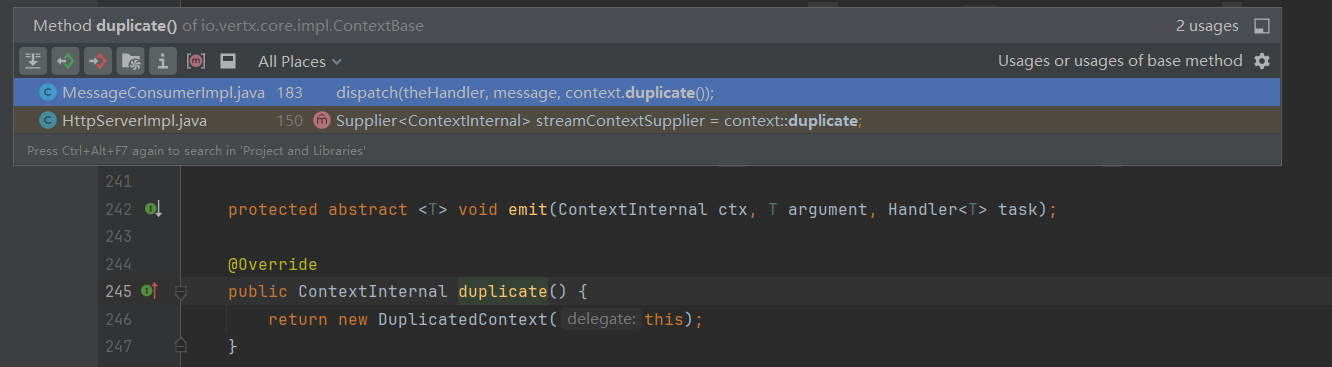
http请求处理中的context变换
查看 HttpServerImpl 代码,发现
  @Override
  protected Handler<Channel> childHandler(ContextInternal context, SocketAddress address, SSLHelper sslHelper) {
    EventLoopContext connContext;
    if (context instanceof EventLoopContext) {
      connContext = (EventLoopContext) context;
    } else {
      connContext = vertx.createEventLoopContext(context.nettyEventLoop(), context.workerPool(), context.classLoader());
    }
    String host = address.isInetSocket() ? address.host() : "localhost";
    int port = address.port();
    String serverOrigin = (options.isSsl() ? "https" : "http") + "://" + host + ":" + port;
    HttpServerConnectionHandler hello = new HttpServerConnectionHandler(this, requestStream.handler, invalidRequestHandler, wsStream.handler, connectionHandler, exceptionHandler == null ? DEFAULT_EXCEPTION_HANDLER : exceptionHandler);
    Supplier<ContextInternal> streamContextSupplier = context::duplicate;
    return new HttpServerWorker(
      connContext,
      streamContextSupplier,
      this,
      vertx,
      sslHelper,
      options,
      serverOrigin,
      disableH2c,
      hello,
      hello.exceptionHandler);
  }
childHandler 方法返回了Handler<Channel>,其实例为HttpServerWorker,里面传入了 Supplier<ContextInternal> streamContextSupplier = context::duplicate; 继续跟进 HttpServerWorker
void configureHttp1(ChannelPipeline pipeline) {
    if (!server.requestAccept()) {
      sendServiceUnavailable(pipeline.channel());
      return;
    }
    HttpServerMetrics metrics = (HttpServerMetrics) server.getMetrics();
    VertxHandler<Http1xServerConnection> handler = VertxHandler.create(chctx -> {
      Http1xServerConnection conn = new Http1xServerConnection(
        streamContextSupplier,
        sslHelper,
        options,
        chctx,
        context,
        serverOrigin,
        metrics);
      return conn;
    });
    pipeline.addLast("handler", handler);
    Http1xServerConnection conn = handler.getConnection();
    if (metrics != null) {
      conn.metric(metrics.connected(conn.remoteAddress(), conn.remoteName()));
    }
    connectionHandler.handle(conn);
  }
发现 传入的 streamContextSupplier 封装到了Http1xServerConnection,然后调用 connectionHandler.handle(conn), 而 connectionHandler 为上面传入的 HttpServerConnectionHandler hello = new HttpServerConnectionHandler(this, requestStream.handler, invalidRequestHandler, wsStream.handler, connectionHandler, exceptionHandler == null ? DEFAULT_EXCEPTION_HANDLER : exceptionHandler); 进入HttpServerConnectionHandler的handle方法
  @Override
  public void handle(HttpServerConnection conn) {
    Handler<HttpServerRequest> requestHandler = this.requestHandler;
    if (HttpServerImpl.DISABLE_WEBSOCKETS) {
      // As a performance optimisation you can set a system property to disable WebSockets altogether which avoids
      // some casting and a header check
    } else {
      if (conn instanceof Http1xServerConnection) {
        requestHandler =  new Http1xServerRequestHandler(this);
        Http1xServerConnection c = (Http1xServerConnection) conn;
        initializeWebSocketExtensions(c.channelHandlerContext().pipeline());
      }
    }
    conn.exceptionHandler(exceptionHandler);
    conn.handler(requestHandler);
    conn.invalidRequestHandler(invalidRequestHandler);
    if (connectionHandler != null) {
      // We hand roll event-loop execution in case of a worker context
      ContextInternal ctx = conn.getContext();
      ContextInternal prev = ctx.beginDispatch();
      try {
        connectionHandler.handle(conn);
      } catch (Exception e) {
        ctx.reportException(e);
      } finally {
        ctx.endDispatch(prev);
      }
    }
  }
可以看到调用ContextInternal ctx = conn.getContext();获取了传入的DuplicatedContext,然后调用ctx.beginDispatch();和ctx.endDispatch(prev); 将connectionHandler.handle(conn);即http处理过程包裹起来,使整个请求处理过程的上下文变成DuplicatedContext,请求处理完成后,还原为之前的上下文。 因此我们可以在请求handler里获取到DuplicatedContext,将需要传递的数据调用putLocal传递。
使用demo
public class MainVerticle extends AbstractVerticle {
    private static final Logger logger = LoggerFactory.getLogger(MainVerticle.class);

    @Override
    public void start(Promise<Void> startPromise) {

        HttpServer server = vertx.createHttpServer();

        Router router = Router.router(vertx);

        router.get("/").handler(ctx -> {
            // 获取vertx请求相关的 DuplicatedContext
            Context reqContext = Vertx.currentContext();
            HttpServerRequest request = ctx.request();
            String user = request.getParam("user","hello");
            // putLocal ctx 到 context
            reqContext.putLocal("ctx", ctx);
            // putLocal 参数 user 到 context
            reqContext.putLocal("user", user);

            handleReq().onComplete(s -> {
                HttpServerResponse response = ctx.response();
                response.end("ok");
            });

        });

        server.requestHandler(router).listen(18080)
                .onSuccess(r -> {
                    startPromise.complete();
                    logger.info("Server started on port {}", 18080);
                })
                .onFailure(err -> {
                    logger.warn("Failed to start", err);
                    startPromise.fail(err);
                });

    }

    private Future<Void> handleReq() {
        return Future.future(f -> {
            Context reqContext = Vertx.currentContext();
            RoutingContext ctx = reqContext.getLocal("ctx");
            String user = reqContext.getLocal("user");
            f.complete();
        });
    }
}
此demo里将请求的RoutingContext和参数隐式传递到了handleReq()方法里面,实现了类似spring里同步请求使用ThreadLocal传递数据的效果,而且没有ThreadLocal的相关安全问题,是不是很方便?
总结
Vert.x里web和EventBus的处理都有自己的上下文,可以用来隐式传递数据,例如请求数据,链路追踪数据,日志Mdc等功能。